By a Public Healthcare Observer
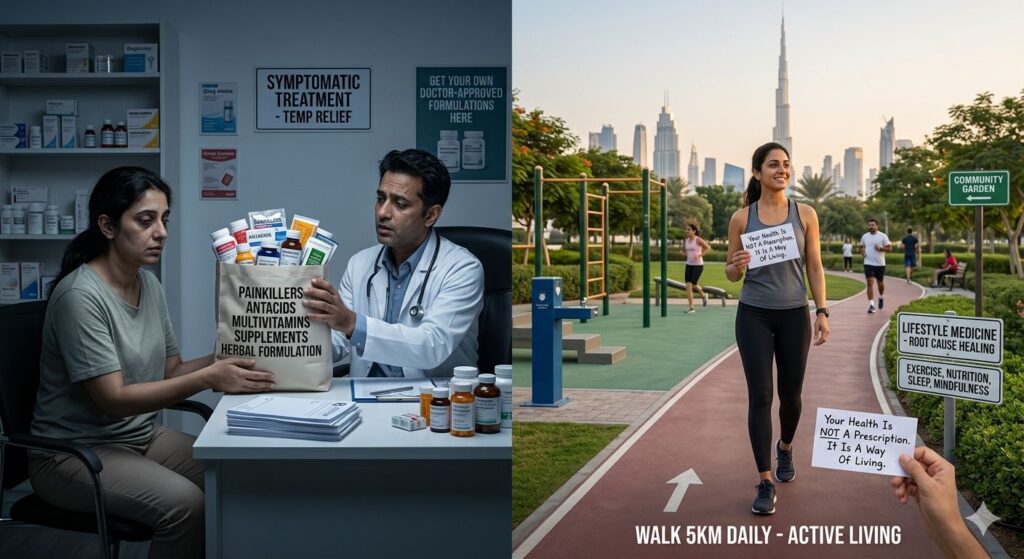
Imagine walking into a dark room and firing an arrow, hoping to hit a target you cannot see. This, unfortunately, is the reality of what we call “classical medical practice” today—a style of treatment that has little to do with healing and everything to do with temporary relief.
In the UAE, a troubling pattern has emerged. Patients walk into clinics with fatigue, body aches, or indigestion, and walk out with a bag full of painkillers, antacids, and high-dose multivitamins. Within weeks, their original symptoms worsen, new problems appear, and they are told they need more medication. This is not healthcare. This is a slow destruction of the body’s natural resilience.
Shooting in the Dark: The Danger of Symptomatic Medicine
True medicine begins with a question: Why does this patient have pain? Why is their digestion weak?
But today, most consultations skip the “why.” There is no detailed general examination, no assessment of localized tenderness, no inquiry into lifestyle, and certainly no discussion of the body’s urgent need for physical exercise. Instead, the focus is on silencing the symptom—as if turning off a fire alarm while the building burns.
When a doctor ignores the body’s demand for movement—to stimulate blood circulation, lymphatic channels, and nerve pathways—they are treating a human being like a machine with a loose screw. The result? Chronic disease, dependency on medication, and a public that believes illness is normal.
The UAE’s Hidden Crisis: Business Over Biology
Unfortunately, this “shoot in the dark” method is not an exception in the UAE—it is the most common practice. Why? Because many healthcare organizations are functioning under immense pressure from their own inadequacies. They have failed to upgrade their clinical practices, invest in proper physical examination training, or incorporate health promotion into their business models.
Instead of correcting this, some practitioners have found a more profitable path: selling their own formulations. These may be brought from their home countries and rebranded as “herbal” or “natural,” sold at two to four times the fair price. Others now promote their own proprietary blends—unregulated, untested, and dangerously positioned as medical solutions.
Let us be clear: When a doctor profits directly from the medicines they prescribe, the patient is no longer a patient. They are a customer. And the clinic becomes a shop.
The Invisible Hand: Why Authorities Cannot Act Fast Enough
The concerned regulatory bodies in the UAE are not blind to these practices. However, the system is struggling to tackle hidden facts—unregistered formulations, off-the-books sales, and the subtle coercion of patients into buying “doctor’s own” products. The lack of strict accountability for healthcare organizations and individual practitioners allows this shadow economy to thrive.
Meanwhile, the visible landscape tells the real story: a chain of fast-food centers on every corner, a pharmacy in every mall, and supermarkets overflowing with packaged, processed foods. But where are the open gardens? Where are the free outdoor gyms for public use? Where are the doctors who spend 30 minutes examining you and then write “walk 5 km daily” instead of a list of 15 medicines?
The Vicious Cycle: Medicines, Multivitamins, and More Medicines
The typical patient in this system receives:
· Painkillers for back pain caused by sitting 10 hours a day.
· Antacids for bloating caused by processed food.
· Multivitamins (in massive, unnecessary doses) for “energy” that exercise would provide naturally.
None of this treats the root cause. In fact, high-dose multivitamins can strain the liver and kidneys. Painkillers mask injuries that need rehabilitation. Antacids alter gut pH, leading to malabsorption and fungal overgrowth. The patient does not get better—they become a lifelong repeat visitor.
What Must Change: A Call to the Public and Authorities
For the Public:
· Stop treating doctors as businessmen. If your physician immediately writes a prescription without a thorough physical exam (checking pulse, abdomen, posture, muscle tone, etc.), walk out.
· Question every “own formulation.” Ask: Is this registered? What are the side effects? Why no generic alternative?
· Demand lifestyle medicine. A good doctor should ask about your sleep, stress, movement, and diet. If they don’t, they are not practicing medicine—they are practicing sales.
· Understand that healing requires effort. No pill replaces 30 minutes of brisk walking. No syrup cleans your arteries like exercise does.
For the Authorities and Healthcare Organizations:
· Mandate accountability. Track prescription patterns. Ban in-clinic sale of doctor-owned formulations unless independently verified for safety and pricing.
· Train staff in health promotion. Employ physiotherapists, nutritionists, and exercise specialists within primary care. Reward doctors who reduce polypharmacy (the use of 10–15 medicines per patient).
· Build public infrastructure. Open gardens, walking tracks, and free outdoor gyms. Health is not made in hospitals—it is made in parks.
· Conduct unannounced audits. Investigate clinics where every patient leaves with the same “special” herbal bottle. Stop the hidden economy of unregistered remedies.
The Bottom Line
Healthcare is not a transaction. It is a relationship between a knowledgeable healer and an empowered patient. When that relationship is replaced by a business model—one that profits from ignorance, rushed visits, and proprietary pills—the only winner is the disease.
Do not accept shooting in the dark. You deserve a doctor who examines, explains, and encourages—not one who sells.
Your health is not a prescription. It is a way of living.
If you or your family have experienced unexplained worsening of health after routine treatment, report the practice to the local health authority. Demand transparency. Demand accountability. Demand real medicine.