The Tale of Two Thighs
Why Muscle is the Organ of Longevity (and Why We Are Failing Our Patients)
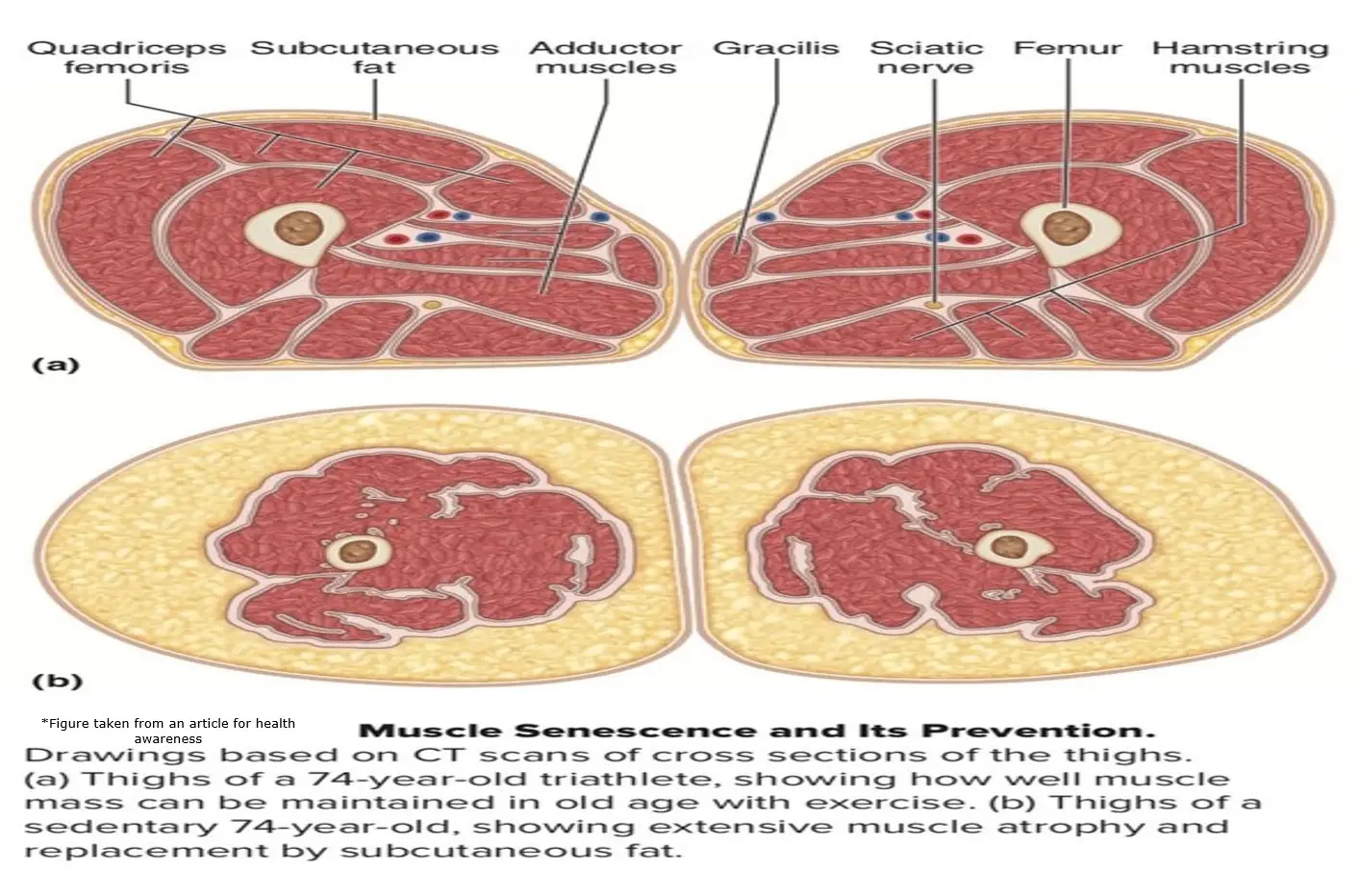
Recently, I sat in front of a monitor studying the cross-sectional CT scans of the mid-thigh. The images on the screen told a story more profound than any textbook I have read in years.
On the left (figure a) was the scan of a 74-year-old triathlete. The image was striking in its clarity. I saw prominent, dense muscle bellies—the quadriceps and hamstrings occupying the majority of the compartmental space. They maintained a fine, robust tone, clearly separated from the adjacent tissues. The neurovascular bundles—the vital highways of arteries and veins—ran along their anatomical paths with zero obstruction, protected and supported by healthy tissue.
Then, I looked at the image on the right (figure b).
This scan also belonged to a 74-year-old. But this individual had a history of a sedentary lifestyle. The difference was not just visible; it was visceral.
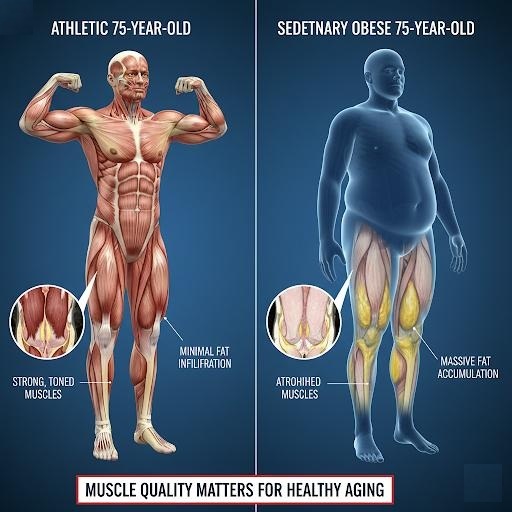
The muscle tissue was markedly atrophied, shrunken away from the fascia. But it wasn’t just “less muscle.” The frightening part was what had replaced it. The intercellular spaces were choked with accumulation of adipose tissue. I saw “junk” yellow fat infiltrating everywhere—wrapping around the bone, sliding between muscle fibers, and obscuring the anatomy. The vital structures, the arteries and veins, were lost in a sea of fatty deposits.
I sat back, astonished. These two people have been on the planet for the exact same amount of time. Yet, biologically, they are different species.
This visual reality check forced me to confront a hard truth about our profession: Why are we, as treating doctors and healthcare professionals, not shouting this from the rooftops?
Why do we treat pain with pills and injections, but fail to explain that the root cause is often the conversion of their active engine (muscle) into dead weight (fat)?
Here is the evidence-based prescription for longevity that every patient needs to hear:
- Resistance Training is Non-Negotiable
Walking is not enough. Walking is great for the heart, but it does not provide the mechanical stimulus required to prevent the atrophy seen in the sedentary scan. You must lift heavy things.
Action: 2-3 days per week of strength training targeting major muscle groups (Squats, Lunges, Push-ups, Rows).
Goal: Hypertrophy (muscle growth) and Strength. We need to fill those thigh compartments back up with contractile tissue.
2. Protein is the Building Block
As we age, we develop “anabolic resistance.” This means an 80-year-old needs more protein per meal than a 20-year-old to trigger muscle protein synthesis.
Action: Increase protein intake. Stop eating toast and tea for breakfast. Prioritize eggs, lean meats, legumes, or whey. The “yellow junk” fat comes from excess refined calories; the muscle comes from amino acids and hard work.
- Intensity Matters
The body adapts to demand. If the demand is low (sedentary life), the structure will be weak. If the demand is high (triathlete life), the structure will be robust.
Action: Do not be afraid of exertion. We must stop telling the elderly to “take it easy.” We should be telling them to “take it heavier” (safely and progressively).
The Failure of the Medical Community
I must be candid here. I felt a deep sense of regret looking at those scans. I regret that the medical fraternity has largely failed to convey this message to the public.
Why? Because, frankly, the messenger is often flawed.
It is an uncomfortable truth that many doctors and healthcare providers are themselves overweight, obese, or sedentary. We have a system where professionals obtain their license and then, for decades, fail to update their knowledge regarding exercise physiology and lifestyle medicine.
We have built a “Sick Care” system, not a “Health Care” system. We are excellent at replacing a knee joint once it is destroyed. We are terrible at prescribing the heavy squats and protein intake that would have saved the knee in the first place.
If a doctor does not value their own muscle tissue—if they do not understand the discipline required to maintain the “triathlete scan” physiology—how can they effectively coach a patient to do it? We cannot lead where we are not willing to go.
The Evidence: Use It or Lose It (Literally)
The literature is irrefutable. We used to believe that muscle loss was an inevitable part of aging. We now know this is a myth.
A landmark study published in The Physician and Sportsmedicine (Wroblewski et al.) analyzed master athletes aged 40 to 81. They found that mid-thigh muscle area did not decline with age in those who maintained high levels of physical activity.
Let that sink in. The atrophy we see in 74-year-olds is not caused by aging; it is caused by disuse.
Wolff’s Law states that bone grows in response to the forces placed upon it. Strong muscles pull on bone, creating density.
Davis’s Law states that soft tissue models along the lines of stress. Without stress (exercise), the tissue becomes disorganized and weak.
When we stop moving, the body effectively says, “Maintenance of this high-energy muscle tissue is too expensive. Let’s break it down and store energy (fat) instead.”
The Roadmap to a Strong, Pain-Free 80
We need a paradigm shift. We need to build a “Strong Pain-Free Community.” This starts with understanding that Muscle is Medicine.
If we want to perform our daily chores independently at 80—if we want to get off the toilet without a grab bar, carry our own groceries, and play with our grandchildren without back pain—we must treat muscle tissue as our most vital asset.
Conclusion: A Call to Arms (and Legs)
The difference between the two CT scans was not genetics. It was choice.
One thigh represents a life of independence, metabolic health, and structural integrity. The other represents a slow decline into frailty, pain, and dependence on the medical system.
It is time we stop blaming “old age” for pathology. Weak muscles create weak joints. Weak muscles create congested, fatty tissues. Weak muscles steal your independence.
As a healthcare community, we must update our skills. We must practice what we preach. We must stop normalizing frailty.
To my patients and my community:
Do not wait for a doctor to write you a prescription for strength. By the time the pain starts, the atrophy has already set in. Look at your own thighs. What do you want them to look like at 74?
The choice to build a strong, pain-free future starts with the very next rep.
Key Takeaways for the Patient:
Pain is a signal of weakness: If your knees hurt, your quads are likely failing to protect them.
Fat isn’t just cosmetic: Intramuscular fat actively degrades your health and mobility.
It is never too late: Muscle tissue is incredibly plastic. It responds to training at 90 years old just as it does at 19.
Independence requires strength: The ability to live alone at 80 is directly correlated to your grip strength and leg power.
Let’s build a stronger community, together.